
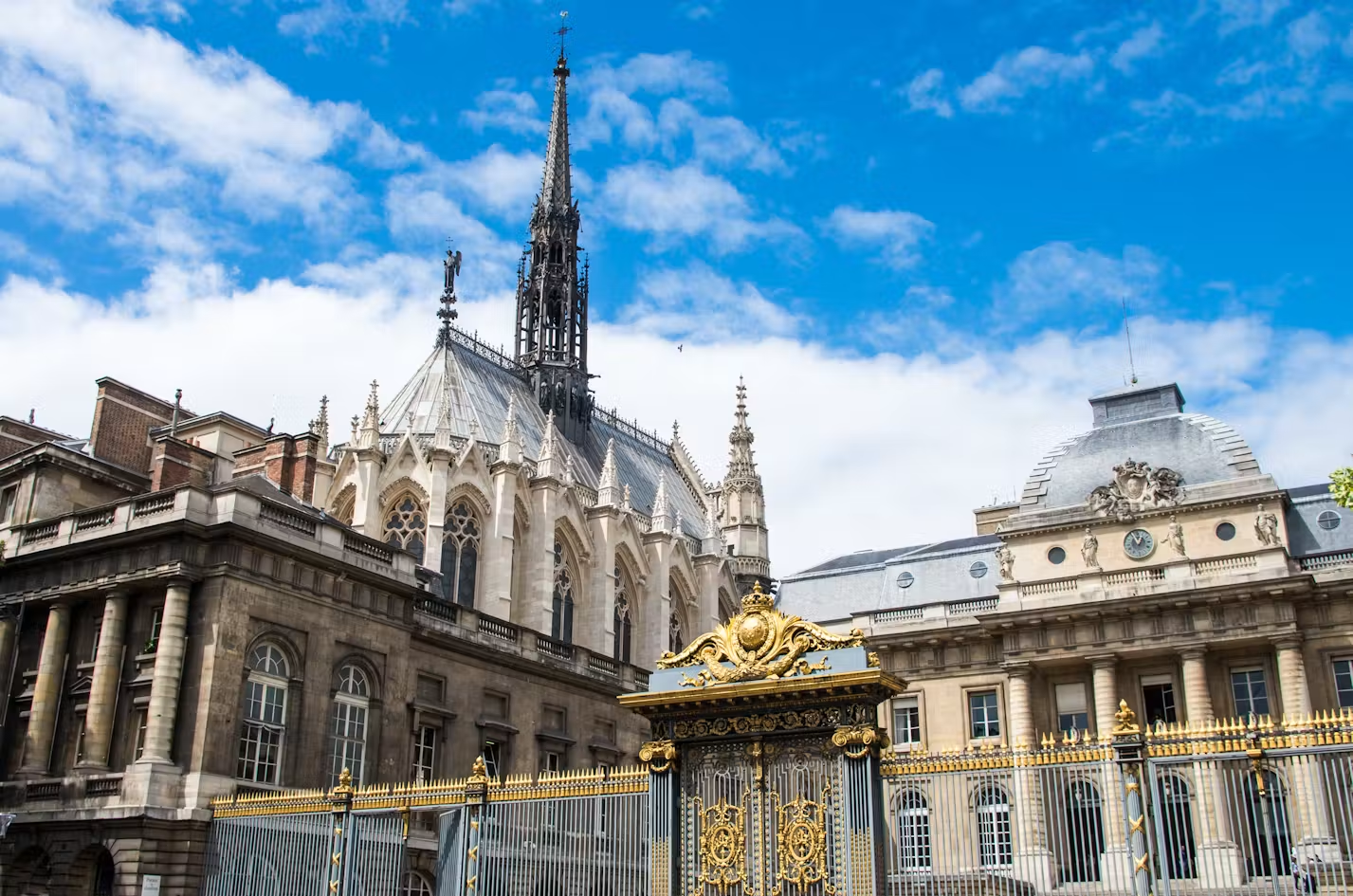

Visit Marie Antoinette's prison at the Conciergerie
Marie Antoinette’s Cell is the most famous spot in the Conciergerie in Paris. Here the Queen of France spent her final days before her death sentence, in one of the emblematic spaces of the French Revolution, now open to visitors inside the monument.
If the whole Conciergerie is a tribute to the Terror, Marie Antoinette’s cell is its emotional and historical core, where one woman’s personal fate is dramatically intertwined with the fall of an entire political era. Marie Antoinette of Habsburg-Lorraine, Queen of France and Navarre, was brought here on the night between 1 and 2 August 1793, transferred from the Temple prison to this damp basement on the Île de la Cité. She spent 76 days here, until 16 October, the day of her execution. What visitors see today is the result of a partial reconstruction and a transformation carried out in 1816 during the Bourbon Restoration, when Louis XVIII decided to turn the original cell into an expiatory chapel dedicated to the memory of his sister and sister-in-law. Despite the architectural changes, the reconstructed layout and furnishings still convey the sense of deprivation and control to which Prisoner Number 280 was subjected. The cell is a cramped, confined space, its rough stone walls seeping with cold and damp. For a woman raised amid the vast spaces of Schönbrunn Palace in Vienna and accustomed to the unrestrained luxury of the Palace of Versailles, such surroundings represented an extreme form of psychological shock. Marie Antoinette, renamed by the revolutionaries “the Widow Capet,” was stripped not only of her rank and possessions, but of something even more fundamental: the privacy of her own body. The cell was divided into two sections by a canvas screen. On one side was the queen’s bed; on the other, two armed gendarmes had strict orders never to lose sight of her, day and night. Her every gesture, every breath, took place under the watchful, intrusive eyes of strangers. More than any execution, this reveals the precise political intent to humiliate the monarchy by attacking the personal dignity of the woman who embodied it. According to period historical accounts, the furnishings reduced the sovereign’s life to the bare essentials: a modest iron camp bed with a straw mattress, a pillow, and a worn blanket unable to protect her from the cold of the Paris nights. Next to the bed, a small wooden desk with a straw-bottomed chair was the only place where she could sit to read religious texts or write. Marie Antoinette spent her days in very poor health; worn down by haemorrhages likely caused by an advanced tumour, prematurely aged, with hair turned white from grief, she found a small measure of comfort in the discreet care of Rosalie Lamorlière, the young prison maid who defied the rules to bring her warm broth, clean sheets and a touch of human compassion.
It was within this narrow cell that preparations were made for the sham trial before the Revolutionary Tribunal. Here the queen faced preliminary interrogations over terrible accusations of high treason, mismanagement of public finances and, most horrifying of all, incest with her seven-year-old son Louis Charles, extracted from the boy through psychological manipulation. It was within these very stone walls, around five o’clock in the morning on 16 October 1793, just hours before being led to the guillotine, that Marie Antoinette wrote her last letter to Madame Élisabeth, her sister-in-law. In the letter, written in a trembling but resolute hand, she expressed no hatred toward her executioners, asked forgiveness for her faults, and urged her children to remain true to their family’s values. Never delivered to its recipient and discovered only later, this letter reveals how the queen managed to shed the frivolities of her past, embracing a tragic, regal dignity. Marie Antoinette’s Cell thus remains the most intimate and silent place in the Conciergerie, where visitors step out of the grand historical narrative to come face to face with the painful vulnerability of human experience.
Iconic places linked to Marie Antoinette
From the royal residence of Versailles to the Conciergerie prison, and on to the Chapelle Expiatoire, these places tell the story of Marie Antoinette’s life, downfall and memory through some of France’s most significant monuments.
Tickets
Site Map